
What Happens to an Opener When the Power Goes Out in Mankato
Mankato homes built mostly between 1950 and 1996 rely on openers that fail when winter power dips.
Read moreMankato homes built 1950-1996 see torsion springs fail hard when cold hits them. Here's why winter breaks springs fast and what actually to do about it.
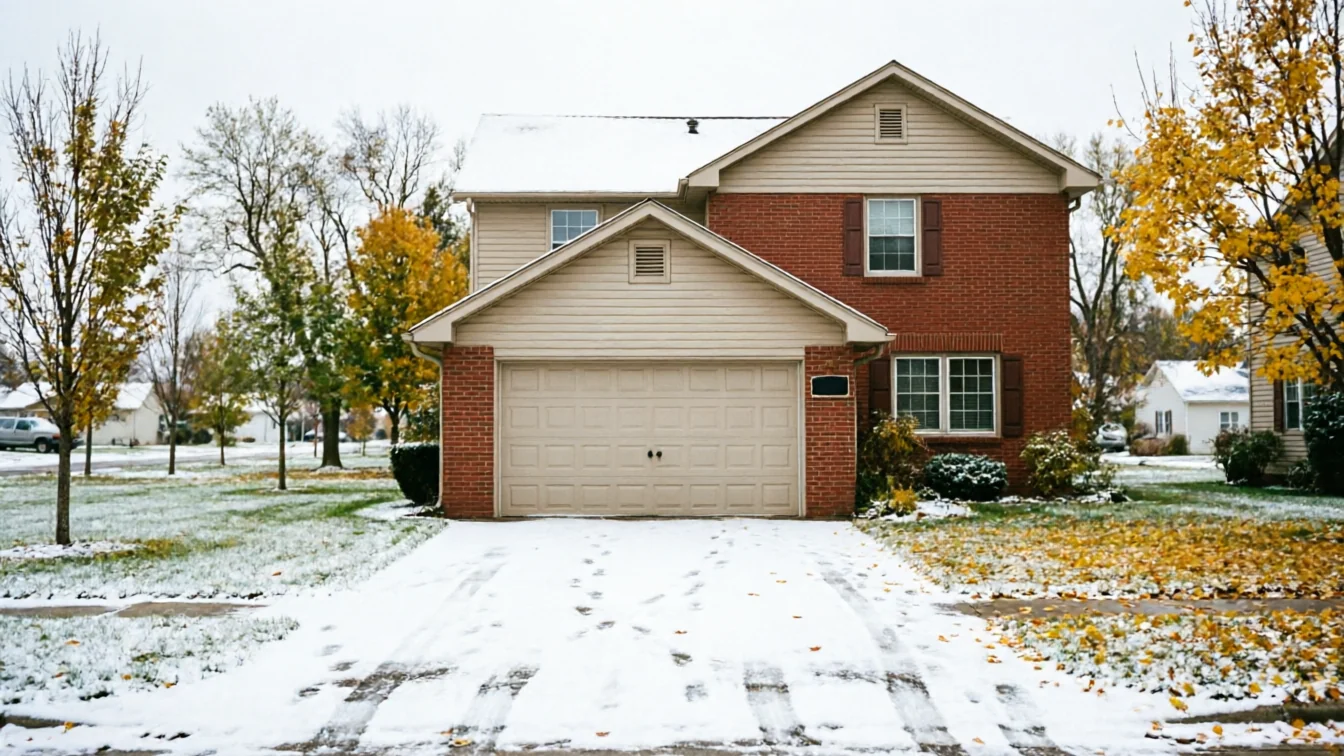
Local detail
If a spring lets go on a night when it's well below freezing, you don't have to fix it at that exact hour. A broken torsion spring means the door won't lift safely on the opener, so the right move for now is to leave the door down, unplug or disconnect the opener trolley, and not force it by hand. That part isn't Mankato-specific - a broken spring is a broken spring anywhere.
What is specific here is what happens if you let it sit through a stretch of cold-severe weather. Most of the houses we get called to went up between 1950 and 1996, with the median around 1975, and that era's torsion hardware wasn't built with today's cycle-life steel. Leaving a car trapped behind a dead spring for a week during a hard freeze isn't dangerous by itself, but it does mean you're running the second spring on a double-spring setup alone, and that one's usually just as old. We won't tell you it has to be same-day - parts lead times and scheduling mean it sometimes isn't - but we won't tell you it doesn't matter either.
The area
The most common mistake isn't ignoring the door - it's trying to help it along. Someone hears the bang, sees the door won't go up on the opener, and decides to lift it by hand or crank the opener manually to "just get the car out." With a dead spring, that puts the full weight of the door - on original hardware from a house built in the 1960s or 70s - on the cables and the opener gears that were never sized for it.
The second mistake is spraying general lubricant on the spring coils thinking that'll loosen things up. On a cold morning that oil just sits there; it doesn't do anything for a spring that's already lost tension. Across the sixteen areas we work in, from here out through North Mankato and Eagle Lake, the housing stock runs similar vintages, and we see the same pattern: a spring that was already worn finally snaps on the coldest morning of the stretch, and the owner's first move makes the repair bigger than it needed to be.
What we find
Mankato sits in a climate band rated cold-severe, which means winter isn't just "cold" - it's repeated hard swings between a mild afternoon and a deep overnight freeze. Steel contracts as it cools, and a torsion spring that's already carrying years of wear loses a little flex every time that swing happens. It's the swing, more than the cold alone, that finishes a spring off.
That matters here specifically because so much of the housing stock - mostly 1960s and 70s builds - is old enough that the springs were never replaced on any kind of schedule. A spring rated for a certain number of cycles doesn't know it's past its date until it's asked to do one more lift on a morning like that, and it just doesn't. With 9,651 owner-occupied houses in the service area built mostly in that same window, this isn't a rare event in any given winter - it's a predictable one, spread across a lot of garages carrying the same age of hardware.
How we work
When a spring breaks in cold weather, what actually happened is usually simple: a spring that was already near the end of its cycle life got pushed over by a cold snap, not caused by it outright. The cold is the trigger, not the root cause. A spring in good condition doesn't care much what the thermometer says.
A median household income of $81,265 around here means most owners can cover a repair without much strain, but we still see people wait out a cold stretch before calling, hoping it'll somehow loosen up on its own. It won't - a snapped torsion spring is a mechanical failure, not a temporary stiffness. The honest limitation here: if the opener motor got forced during that waiting period, that's a separate repair on top of the spring, and we won't know which until we're looking at it in person.
Questions
The cold didn't cause the failure by itself - it pushed a spring that was already near the end of its life over the edge. Steel loses flex as it contracts, and a spring that's been cycling for decades, common in homes built here in the 1960s and 70s, has less margin left to absorb that swing.
Yes, as long as you disconnect the opener and don't try to force the door by hand. Leaving it down doesn't make anything worse. Just don't run the opener against a dead spring, since that puts extra strain on the second spring and the opener gears.
Lubricant helps reduce friction on coils and the track, but it doesn't restore tension to a spring that's already fatigued. If the spring snapped, no amount of oil brings it back. If it hasn't snapped but feels weak, that's worth a look before it does.
Recommendation
More garage door guides for Mankato homeowners.
Mankato homes built mostly between 1950 and 1996 rely on openers that fail when winter power dips.
Read more
A straight look at what our service call actually checks on Mankato homes, most built between 1950 and 1996, through a cold-climate winter cycle.
Read more
Mankato's housing stock mostly dates to the 1960s-70s with a 1975 median build year, and the cold climate band here turns small door problems into bigger ones fast.
Read moreReady when you are
Mankato Garage Door Pros repairs and installs garage doors, springs and openers in Mankato, MN and the surrounding area.